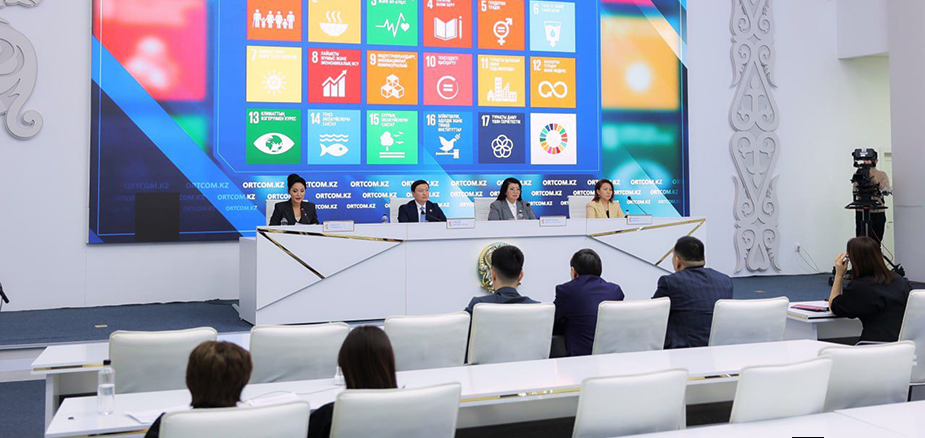
 On 24 December, the key results of the Third Voluntary National Review (VNR) of the Republic of Kazakhstan on the achievement of the Sustainable Development Goals (SDGs) were presented at the Central Communications Service under the President of the Republic of Kazakhstan.
The
speakers included Asan Darbayev, Vice Minister of National Economy of
the Republic of Kazakhstan; Nurgul Zhannazarova, Director of the
Department for Social Development, Law Enforcement and Special Bodies
of the Ministry of National Economy of the RK; and Bakytgul Khambar,
Director of the SDG Secretariat of JSC “Economic Research Institute
” of the Ministry of National Economy of Kazakhstan.
Within
the framework of the United Nations High-Level Political Forum in New
York, Kazakhstan presented its Third Voluntary National Review on the
implementation of the Sustainable Development Goals. In 2025
Kazakhstan was among the 37 countries that presented national reviews
at the UN global platform.
The
Third National Review (2025) marks a transition from the stage of
building the institutional framework for SDG implementation (First
Review, 2019) and integrating the SDGs into the public administration
system (Second Review, 2022) to the stage of assessing effectiveness
and consolidating the progress achieved.
During
the event, the results of a comprehensive analysis of the
implementation of national sustainable development priorities were
presented. The document includes a systematic analysis of
interlinkages among more than 60 national indicators, making it
possible to identify goals and areas with the greatest impact on
Kazakhstan’s overall sustainable development progress.
The
Review was prepared in an open and inclusive manner, based on the
“Listening State” principle. Approximately 5,000 participants
from across the country took part in discussions, including
representatives of government bodies, business, non-governmental
organizations, international partners, the expert community and
youth.
A
key feature of the Third Voluntary National Review was the
presentation of two parallel progress assessments: the Government of
Kazakhstan’s assessment and an independent civil society assessment
conducted using the People’s Scorecard methodology.
Special
attention in the Review was given to youth, as 28 % of Kazakhstan’s
population is under the age of 35. As part of the preparation
process, a survey of more than 3,000 young people was conducted,
along with a nationwide essay competition among school students,
where participants shared their vision for SDG implementation.
During
the press conference, journalists raised questions related to the
principles of the Regional Development Concept until 2030, child
well-being, the quality of disaggregated data, and mechanisms for
translating the findings of the Voluntary National Review into
regulatory and budgetary decisions. The speakers provided detailed
explanations on all issues raised.
In
particular, it was noted that the key principle of the Regional
Development Concept is “leaving no one behind,” implemented
through a regional standards system. It was explained that the Child
Well-Being Index is used as a monitoring tool for annual assessments
of the situation in the regions. It was also emphasized that
significant progress had been made in improving the quality of
disaggregated data during the preparation of the Review: 52% of
indicators (102 out of 200) now have at least one type of
disaggregation. This improvement was supported by the results of the
Multiple Indicator Cluster Survey on the situation of women and
children, conducted in 2024.
To
ensure continuous progress monitoring, starting from 2026 an annual
SDG implementation report is planned to be introduced. The report
will be prepared by the SDG Secretariat of “Economic Research
Institute” JSC and will serve as a tool for analyzing trends in
national indicators and developing recommendations to accelerate the
achievement of the SDGs.