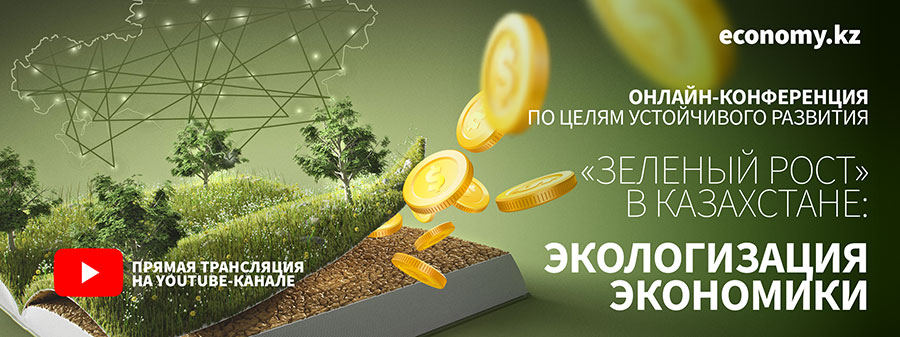
On September 23, 2020, an online "Green growth" sustainable development goals in Kazakhstan: greening the economy" Conference was held in memory of Saltanat Rakhimbekova, a public figure in the field of "green" economy.
"The natural capital of our country is enormous, we are the fifth in the world in terms of pasture land area, the third in the area of land not contaminated with agrochemicals and GMO crops, we have many reservoirs, we have natural tourism and recreation potential."
Saltanat Rakhimbekova
Founder, Head of NGOs – G-Global Green Economy And Development Coalition, EXPO&Women,
Agricultural Union of Women of Kazakhstan, Civil Alliance of Kazakhstan
•How to make natural potential the basis of economic success?
•What production technologies should be implemented so as not to harm all the living?
•How to restore the potential of ruined ecosystems?
•What can an ordinary person do to transfer a prosperous country to children?
Friends, students, followers of Saltanat Rakhimbekova, as well as independent experts spoke about this and much more at an online conferenc.organized by the Economic Research Institute.
The first speaker was Toleutay Rakhimbekov, the Chairman of the Management Board of the National Agrarian Research And Educational Center Non-Profit JSC, husband of Saltanat Rakhimbekova.
"Saltanat, indeed, gave a lot of effort to work in the field of green economy. She had been working on this issue for a long time. ... We were engaged in completely new technologies, which even today, after 30 years, are unknown to many specialists and scientists. These are issues of bridge farming, farm electrified technologies, which are directly related to the agricultural ecology.
She was particularly impressed when in 2013 our Yelbasy, the First President, signed a decree approving the concept of Kazakhstan's transition to a green economy. Around this time, she formed For a Green Economy G-Global. Saltanat gathered around her the devotees, altruists who worked for the very idea of greening the economy.
She was very active in promoting the UN Sustainable Development Goals. This is the 2nd goal, which was related to agriculture; SDG 13, which calls on all of us to actively take up the challenges associated with climate change."
Speaking about the development of the green economy, Rakhimbekov noted the special importance of soil conservation and protection of agriculture from climate change. Toleutay Satayevich, Doctor of Economics, academician, scientist in the field of formation and development of AIC processing sub-complex, is concerned about agro-industrial issues today:
"I keep trying to remind specialists and officials that in addition to the current problems of agriculture, there are two global problems that the industry faces. The first is global climate change. In the development of agriculture, the state cannot ignore this issue. The number of dry periods increases from year to year. And this should be taken into account when developing public policy. The second problem is soil degradation."
The pandemic has highlighted the importance of agriculture. According to the expert, the number of people at risk of starvation will increase by several hundred million people. Kazakhstan can contribute to this problem solution, due to the potential for the agricultural production - environmentally safe food.
"The pandemic affects not only people and business, but also the environment and the economy," Vitaly Vremish says, the Deputy Permanent Representative of UN Development Program in Kazakhstan. As he noted in his welcome speech, the corona-crisis threatens the goals of sustainable development.
"Today, achieving SDGs, in particular social goals, as well as goals related to the fight against climate change, requires a long-term approach in which the government, we, the private sector and civil society address these challenges. I am pleased to note that Kazakhstan continues to work on implementing the concept of transition to a green economy. During the pandemic, the meeting of the Green Economy Council was prioritized. The efforts that were planned at the beginning of the year are also continuing. Green growth is in the President's Address, so there are good prerequisites for further work on "green" Goals," the international expert said at the conference.
"Certainly, the sustainable development goals are comprehensive. And the fact that Expo&Women dealt with agricultural issues, involving women in this process, will deliver benefits," Aigul Sagadibekovna said.
Aigul Solovyova, the Chairman of the Management Board of Association of Environmental Organizations of Kazakhstan ALE, was a close friend of Saltanat Rakhimbekova. Together they worked on large-scale projects such as Expo&Women. This is a new concept for involving women and feminist movements in support of the contribution of Expo exhibitions to sustainable and inclusive development, transition to a new technological paradigm, future society models, innovative charity and social entrepreneurship.
The main part of the conference consisted of presentations on new public and private developments in the field of green economy.
Zulfiya Suleimenova, the Deputy Director of the Climate Policy and Green Technology Department of MEGNR RK, reported on the design of Low-Carbon Development Strategy of the Republic of Kazakhstan.
This document is being developed within the framework of the Paris Agreement, which calls on the parties to create long-term strategies with a low level of carbon development. The basis for its development is also SDG 13, an indicator of which should be measures to combat climate change.
The speaker noted that the Strategy will determine the long-term development of Kazakhstan, taking into account decarbonization, which was mentioned by the Head of State in his address dated September 01, 2020. When developing the document, external factors for the economy of Kazakhstan are also taken into account. For example, The European Union just last year accepted the European Green Deal, and a Climate Pact is being developed as part of this document.
"We expect that China is working very seriously in the framework of climate policy, which will affect us. Regarding Russia, the Russian Federation has adopted the Low-Carbon Development Strategy this year. We see a great interest of large companies in low-carbon development. Based on this international situation, aspects of processing the new document are taken into account," Suleimenova said.
According to her data, the prospects for the development of the domestic economy are calculated according to six scenarios, three trajectories of domestic policy and on the basis of international factors.
"We held consultations with the involvement of stakeholders, and we also managed to hold sectoral consultations in 4 areas: agriculture, building, transport and coal industry. We received about 40 comments from stakeholders – from the academic community, NGOs, and governmen.organizations, which we took into account. Matrices are prepared for modeling. The next step will be to form a working group, both at a high level and at a technical level, to begin the upgrade process for scenarios. We expect the document to be ready next year," the speaker explained.
Lyazat Askarova, the Executive Director of Expo&Women, considers the low involvement of civil society in achieving the sustainable development goals in Kazakhstan to be one of the urgent problems of the green economy. Active public participation in the implementation of the Goals could significantly contribute to the green growth. However, according to Expo&Women surveys, the population is not sufficiently informed about this area.
"More than half of the respondents said they had heard about SDGs. Only 8.4% are familiar with this program as a whole and not even everyone knows that these are 17 Goals," Askarova explained during an online conference,adding that more than 600 people took the survey.
The expert said that a survey system has been established that will help increase the expertise of those involved in the Sustainable Development Goals. It should be noted, that green economy issues are given more attention both in SDG projects and in OECD documents. 80 out of 244 OECD indicators relate to the greening of the economy.
Bakhyt Yessekina, the Director of Green Academy Research and Education Center, spoke about OECD Green Growth Indicators for SDGs of Kazakhstan: "OECD identifies 54 indicators. We tested these indicators on the national statistics. And, 44 indicators can be found in the statistics."
The Head of the Green Academy noted that some indicators should be paid special attention to. Labor productivity; CO2 emissions per capita; green investments, research projects related to the green economy. Kazakhstan will have to work systematically on these indicators.
Site policy When working with site materials, it is allowed to use text with a mandatory hyperlink to the source. The editors of the site do not always share the opinions of the authors of the articles.