24.08.2020
Experts commented on the World Bank Report on the economy of Kazakhstan
The consequences of the pandemic, global economic instability and low oil prices will affect the country's medium-term development prospects.
Experts predict that the pandemic and its economic consequences will lead to an increase in global poverty for the first time since 1990. A further economic downturn will increase social inequality around the world. Preliminary World Bank estimates for Kazakhstan show that GDP will decline by 3% in the next six months, followed by a recovery of 2.5% in 2021. And more detailed forecasts of the World Bank make seriously think about the welfare of the country.
Analysts at the Economic Research Institute explain how objective these concerns are.
ABOUT GDP
Experts:
Kaisar Nigmetov
Director of the Center for Regional Studies
Nurbolat Kurmetuly
Deputy Director of the Center for Regional Studies
Already in the first half of 2020, the volume of GDP decreased by 1.8% compared to the corresponding period last year. However, today's economic statistics are not as frightening as they might seem.
Industrial production increased by 1.3%, including manufacturing - by 3.8%. The mining industry declined by 0.4% as a result of a planned decline in the rate of oil production.
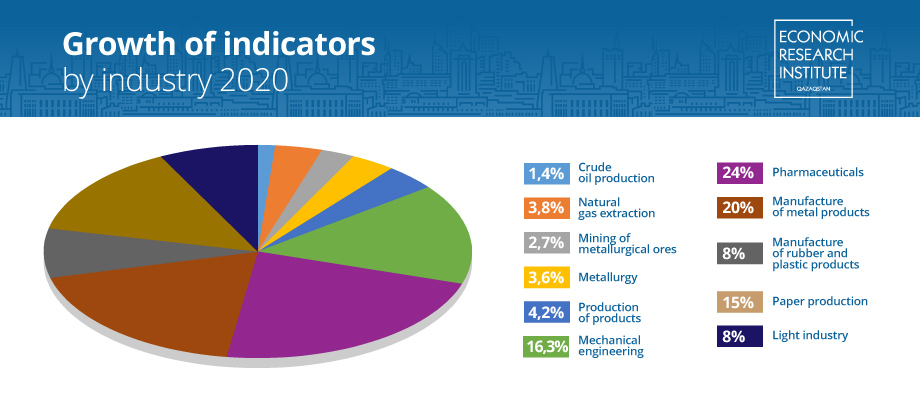
In the manufacturing industry, growth was achieved by 3.8%, including in mechanical engineering - by 13.9%, food production - by 4.1%, pharmaceuticals - by 23.2%, light industry - by 7.3%, paper production - by 15.7%, chemical industry - by 3.6% and the production of finished metal products - by 18.6%. Construction volumes increased by 6.3%, housing commissioning - by 7.5%, or about 7.0 million square meters. In agriculture, a steady growth of 2.5% was achieved.
At the same time, in January-June, the volume of services rendered decreased compared to the same period in 2019. The decreasing is 6.9%. The largest decrease is observed in Atyrau (by 17.7%), Mangistau (by 9%) regions and Almaty (by 12.4%).
In Nur-Sultan (by 17.5%) and Almaty (by 18.5%), the largest decline in retail trade volumes was observed in the first half of the year.
There is also a decline in retail trade in all regions of the country. The smallest decrease is observed in the city of Shymkent (by 2%), Kostanay (by 2.3%), Almaty (4.1%) and Zhambyl (4%) regions.
The situation shows how strongly the indicators of the two largest cities affect the country's economic development, which once again underlines the need to develop other cities and turn them into "growth points".
The forecast scheme for territorial and spatial development of the country until 2030 and the State Program for regional development for 2020-2025 provide for the development of 18 FUA (functional urban areas). This is in addition to Nur-Sultan, Almaty and Shymkent, 15 cities of regional significance. All of them are intended to become "growth poles" and drivers of the country's socio-economic development in the future. It is obvious that despite the frightening forecasts, the state has the tools to overcome the crisis and restore the economy.
About anti-crisis measures
The poverty level may increase in 2020 from the projected 8.3 to 12.7 percent, which corresponds to more than 800 thousand people in need, international experts said.
Analyzing the preliminary WB statistics, it is important to note that according to the international poverty indicator, already now about 10% of Kazakhstan people live at its threshold (the current WB absolute poverty line is $ 1.9 per day - ed.). So, according to the Committee for Statistics of the Ministry of National Economy for Q1 2020, 10% of the population have an average per capita income of about KZT 25 thousand per month, which is about $ 1.99 per day. In Q1 2020, about 30% of Kazakhstan people had an income of up to $ 3.2 per day, i.e. 5.4 million people (the moderate poverty line at the consumption level is $3.2 per day).
Expert:
Madiyar Kenzhebulat
Leading Researcher at the Center for Macroeconomic Research
In world practice, there are several concepts for defining poverty. The poverty line is the level of disposable income, gross income, or consumption below which a person is considered poor. The absolute poverty line, as an indicator, has one significant drawback: it does not take into account the number of households directly above it with a small margin from it. It also allows for situations where poverty and inequality are increasing and the number of people below the poverty line is decreasing.
There is also an indicator of subjective poverty, which can be identified based on public opinion, and then compared with the income of the population. There are other parameters of this social phenomenon, so focusing only on one or two indicators will not give a complete picture.
Speaking of the situation as a whole, the current global crisis has surpassed all the crises of the past decades in its destructive power. All countries of the world have faced such consequences as rising unemployment, falling real incomes, rising poverty, etc.
It is important to note that in these difficult conditions, the Government of the Republic of Kazakhstan has taken measures to mitigate the consequences of the global crisis:
KZT 1 trillion 788 billion was allocated for employment and infrastructure development. The money is used to repair roads, bridges, reconstruct housing and social infrastructure within the framework of the Employment Roadmap, as well as to build housing under the Nurly-Zher State Program.
KZT 1 trillion 34 billion was allocated to support small and medium-sized businesses. Until June 1, 2020, all taxes and social payments were deferred for SMEs.
KZT 150 billion was allocated for the development of the agro-industrial complex. For agricultural producers, the land tax rate has been reduced to 0%. In the field of livestock breeding, it is possible to pay VAT using the offset method for imported goods.
Overall, significant support was provided in the 29 most affected sectors of the economy.
During the emergency, in April and May 2020, a total of 4.5 million people received payments of KZT 42,500. After the decision to tighten quarantine measures in July, the payment of KZT 42,500 was assigned to 2 million 80 thousand people. The funds were transferred to 2 million 58 thousand Kazakhstan people.
All the above measures helped to mitigate the impact of the global crisis on the economy of the Republic of Kazakhstan. Thus, despite the decrease in real wages in June (by June last year) in real terms by 5.6% - for the period January-June 2020 by January-June 2019, there was an increase in the real wage index by 5.5%.
Experts:
Kaisar Nigmetov
Director of the Center for Regional Studies
Nurbolat Kurmetuly
Deputy Director of the Center for Regional Studies
The report notes that the Government of Kazakhstan promptly took decisive measures to control the spread of COVID-19 and mitigate its impact. The Government allocated KZT 125.2 billion ($ 297 million) for the implementation of coordinated measures to combat the pandemic. It was also noted that to protect the population and businesses from the accompanying economic downturn, the government announced a package of "anti-crisis" measures in the amount of 5.7% of GDP.
As for monetary payments to people who lost their jobs due to the closure of enterprises and isolation during the emergency, in total, about 4 million people received the first benefit in the amount of KZT 42,500. The largest number of recipients was in the Almaty region – 567.3 thousand people, the smallest number of recipients in the North Kazakhstan region - 90 thousand people. In general, 941 thousand people received benefits in three cities of national significance (Nur-Sultan, Almaty, Shymkent). In the oil-producing Western regions (Atyrau, Aktobe, West Kazakhstan, Mangistau), the number of recipients was 590 thousand people. In the Central-Eastern industrial regions (East Kazakhstan, Pavlodar, Karaganda), 635.1 thousand people received benefits. In the Southern regions (Almaty, Zhambyl, Kyzylorda, Turkestan), the number of recipients was 1.4 million people. In the Northern regions (Akmola, Kostanay, North Kazakhstan), the number of recipients was 378 thousand people.
As the analysis of the number of recipients of the first social payment in the amount of KZT 42,500 shows, the most recipients are in the agricultural southern regions.
In this regard, taking into account the structural features, the diversification of their economies based on accelerated development of manufacturing, agriculture, transport and logistics, and high-value-added services will be of key importance for agricultural and industrial regions.
About oil
According to the World Bank, in a situation with quarantine vulnerable and other segments of the economy, such as: non-food retail trade, aviation and transportation industry, power industry, services sector and so important for Kazakhstan oil, gas and mining sectors.
The Report notes that in March, oil prices fell to a 17-year low of about $ 25 per barrel amid disagreement over production cuts among OPEC+ partner countries and expectations of weak demand. The economic consequences of the coronavirus pandemic include reduced demand for oil.
Expert:
Shyngys Shuneyev
Deputy Director of the Center for Macroeconomic Research and Forecasting
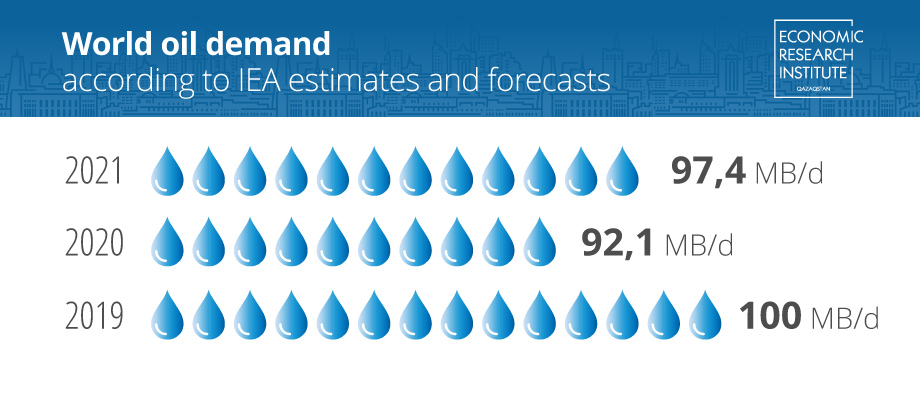
The International Energy Agency (IEA) notes that the worst decline in demand occurred in the first half of this year, when demand fell by 10.75 million barrels per day (MB/d). In the second half of the year, the IEA expects the decline in demand to slow down to 5.1 MB/d. Thus, according to IEA estimates, global oil demand in 2020 will average 92.1 MB/d, which is lower by 7.9 MB/d from the level of 2019. In 2021, demand will increase by 5.3 MB/d to 97.4 MB/d.
As for supply, according to the IEA, global oil production in June fell by 2.4 MB/d to a nine-year low of 86.9 MB/d. Strict compliance with the OPEC+ agreement on oil production and sharp declines by other producers led by the US and Canada have reduced global oil production by almost 14 MB/d since April. If the OPEC+ commitments to reduce oil production are met as agreed, global oil production could fall by 7.1 MB/d in 2020 before a modest recovery of 1.7 MB/d in 2021.
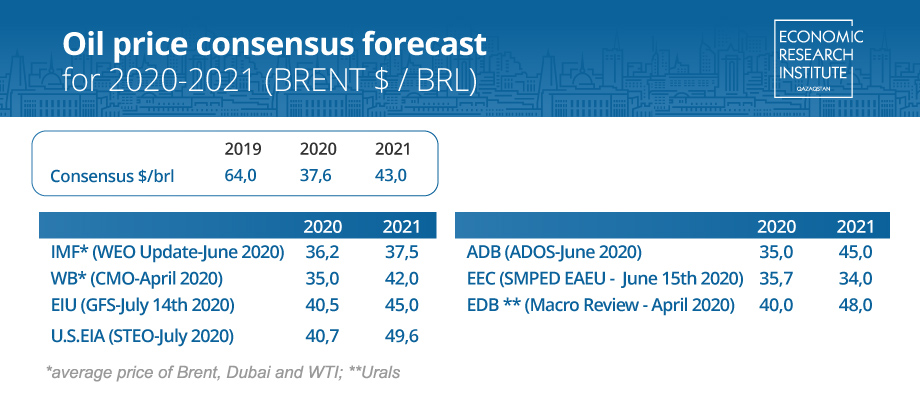
Thus, international financial institutions and energy agencies are expected to reduce world oil prices by 41.3% (37.6$/brl) in 2020 relative to the average level of 2019 (64$/brl). In 2021, oil prices are expected to rise to 43$/brl (the range of fluctuations is 37.5-49.6$/brl).
Assuming an average annual oil price of 40$/brl, oil and gas condensate production - 86 million tons, the average annual exchange rate - KZT 416 per $1 and also taking into account the quarantine measures and financial means of anti-crisis measures, we expect a slight positive growth in the manufacturing industry and a decline of 3.1% in the mining industry.
Expert:
Madiyar Kenzhebulat
Leading Researcher at the Center for Macroeconomic Research
Since March of this year, oil prices have increased almost 2 times (about 45 $/brl by the end of July 2020).
The US Department of Energy predicts that global oil and liquid fuel consumption will average 92.5 million barrels per day in 2020, down 8.3 million barrels per day compared to 2019, and then increase by 7.2 million barrels per day in 2021.
OPEC has improved its forecast for a decline in global oil demand in 2020 by 100,000 barrels per day (b/d). Thus, OPEC expects a drop in global demand by 8.9 million b/d this year, according to the July report of th.organization.
At the same time, according to the consensus forecast, the average price for Brent oil will be 38 $/brl, which is much better than we expected at the end of March.
At the same time, our country's commitments to reduce oil production under the OPEC+ agreement, according to our forecasts, will lead to a decline in the mining industry by the end of 2020. So, at the price of oil 38 $/brl on average for 2020 and oil production of 86.3 million tons, the mining industry will decline by 3.1%.
Relatively favorable conditions on the metal market and government support measures will contribute to the growth of the manufacturing industry by 2.2% in 2020.
Experts:
Kaisar Nigmetov
Director of the Center for Regional Studies
Nurbolat Kurmetuly
Deputy Director of the Center for Regional Studies
In connection with the unfavorable situation on world markets of oil-producing regions of the country are faced with serious problems. Both large oil companies and other small companies that provide services in oil production and refining were affected. Despite the overall increase in production volumes for the Republic in January-June 2020, oil production decreased in the Kyzylorda (by 15.7%), Aktobe (by 14.9%) and Mangistau (by 3.9%) regions. In the West Kazakhstan region, natural gas production was reduced by 2%. In a number of regions, the volume of services in the mining industry decreased: in the Atyrau region - by 7.2%, in the Kyzylorda Region - by 9.5%.
The fall in oil prices has led to a reduction in taxes in the oil-producing regions. Thus, in January-June 2020, compared to the corresponding period of 2019, the volume of taxes to the state budget in the oil - producing regions decreased by almost 30%, including in the Aktobe region - by 32.3%, Atyrau - 27.1%, West Kazakhstan - 31.4%, Kyzylorda - 18.3%, Mangistau - 36%.
The current situation has a negative impact on these regions in terms of employment, income, and overall economic development.
Even before the start of the pandemic, the Forecast Scheme of the country's territorial and spatial development until 2030 noted that due to the continued depletion of natural resources in the extracting regions, it would be necessary to take measures to further diversify the economy, create jobs, and reduce budget revenues. In addition, it is necessary to provide a set of measures to facilitate voluntary relocation.
About the national debt
Against the background of a decrease in these indicators, the national debt of Kazakhstan will grow to 30% of GDP, the World Bank predicts. It is noted that the national loan index will remain stable, despite plans for additional borrowing on international capital markets. (At the end of 2019, the total public debt of the Republic of Kazakhstan amounted to 25.1% of GDP).
This scenario is quite likely, according to the ERI experts, since the budget deficit will also increase in the context of the growth of anti-crisis measures.At the same time, as noted by economists, the level of 30% of GDP Is quite comfortable - according to best practices, the level of public debt within 60% of GDP is safe (data from the Maastricht Treaty for EU countries).
Sources of growth (instead of completion):
The impact of external economic shocks will continue to soften the reserves of the National Fund. Although the World Bank estimates that foreign exchange reserves in the NF will fall below the threshold of 30% of GDP in the coming years, they still provide significant protection for the country's financial position.
Speaking of attracting additional investment, the source of growth can be a tool of public-private partnership…
For more information, see Baltabay Syzdykov's expert analysis, which will be released on August 25.
All articles