OECD International Webinar on Leveraging Defence Investments for Local Development
16.03.2026
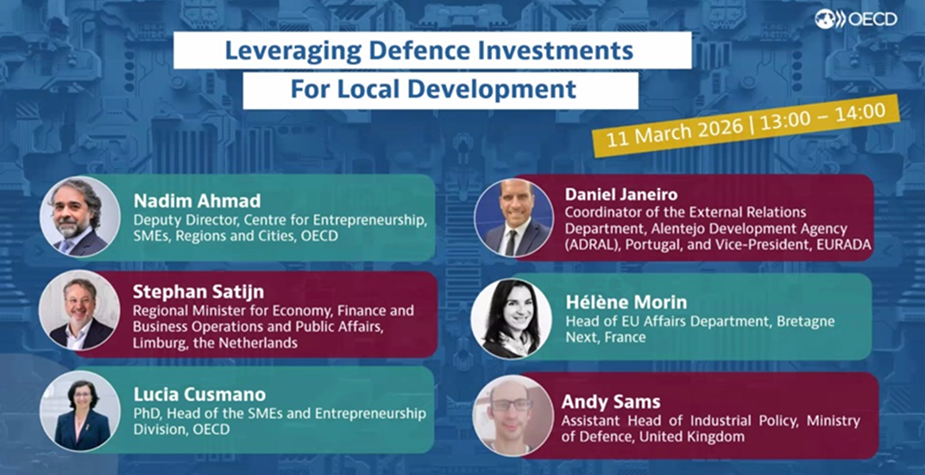
On 11 March 2026, representatives of the Economic Research Institute took part in an international webina.organized by the Organisation for Economic Co-operation and Development (hereinafter referred to as the OECD) on the topic “Leveraging Defence Investments for Local Development.” The event was held as part of the preparations for the OECD Global Forum on Local Development 2026 and focused on discussing how rising defence spending can contribute to local development, industrial modernization, job creation, and the strengthening of workforce capacity.
The webinar brought together representatives of the OECD, national and regional authorities, as well as members of the expert community from the Netherlands, the United Kingdom, Portugal, and France. The main speakers included Nadim Ahmad, Deputy Director of the OECD Centre for Entrepreneurship, SMEs, Regions and Cities; Stephan Satijn, Regional Minister for Economy, Finance, Business Operations and Public Relations of the Province of Limburg; Andy Sams, representative of the UK Ministry of Defence; Daniel Janeiro, Coordinator of the External Relations Department at the Alentejo Regional Development Agency (ADRAL) and Vice-President of the European Association of Development Agencies (EURADA); and Hélène Morin, Head of the European Union Affairs Department at Bretagne Next. The discussion was moderated by Lucia Cusmano. Opening the event, OECD representatives emphasized that defence investments should be seen not only as a security instrument, but also as a driver of local and regional development. It was noted that defence industries stimulate demand for skilled labor, support the development of high-tech manufacturing, create opportunities for small and medium-sized enterprises and researc.organizations, and facilitate the diffusion of dual-use technologies into civilian sectors of the economy. Stephan Satijn presented a regional perspective on defence investments as a source of economic renewal. Using the example of the Province of Limburg, he demonstrated that the defence agenda can be linked to the development of high-tech manufacturing, logistics, infrastructure, and public-private partnerships. In his view, such investments can strengthen not only security, but also the innovative capacity of regions.
Daniel Janeiro presented a European and regional perspective using the example of the Alentejo region. He noted that, against the backdrop of the situation in Ukraine and Europe’s course toward reindustrialisation, the defence sector is increasingly being viewed as a source of regional economic and technological growth. In this context, Smart Specialisation Strategies (S3) needs to become more flexible and more territorially oriented. Among Alentejo’s priorities, he identified dual-use technologies, including artificial intelligence, cybersecurity, augmented reality, and data analytics. Hélène Morin presented the French regional experience, placing particular emphasis on cooperation among universities, development agencies, local authorities, professional associations, research institutions, and businesses. Special attention was given to the Craft platform, seen as a tool for coordinating competencies, value chains, and areas of specialization. At the conclusion of the webinar, it was noted that in OECD countries defence investments are increasingly being regarded as a cross-sectoral instrument capable of simultaneously addressing security needs, industrial modernization, human capital development, and the strengthening of regional resilience.
Views: 1518 |
|
||||||||||||||||||||||||||||||||||||||||||||||||||||||||||||||||||||||||||||||||||||||||||||||||||||||||||||||||||||||||||||||||


|