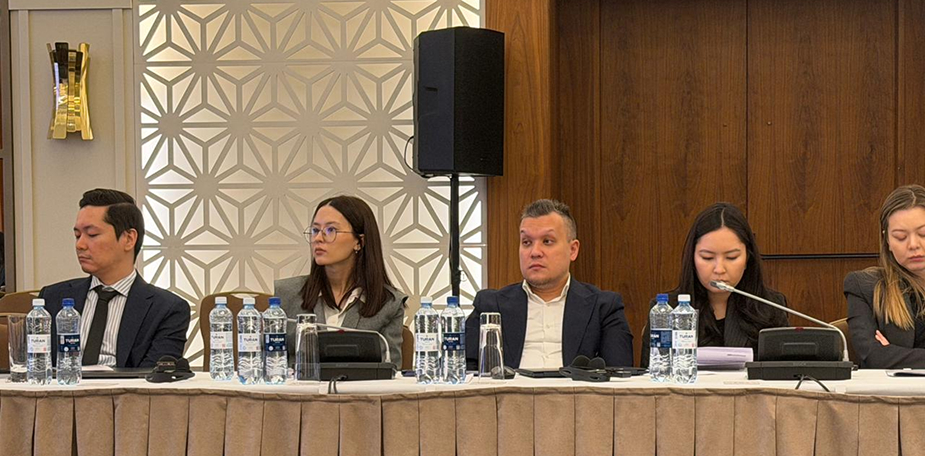
 On March 19, 2026, in Astana, at the Sheraton Hotel, an analytical review presentation and expert seminar were held as part of the OECD project “Enhancing Safety and Transparency in the Management of Critical Minerals in Central Asia”.
The
event brought together representatives of the government of the
Republic of Kazakhstan, including the Ministry of Industry and
Construction, the Ministry of Finance, and the Ministry of Ecology
and Natural Resources, as well as participants from quasi-state and
private sectors, internationa.organizations, and the expert and
academic community. From the Institute for Economic Research, staff
from the Center for Global Economic Studies took part in the seminar.
The
objective of the event was to present the key findings of the new
OECD review and to expand dialogue among government authorities,
businesses, and civil society on the establishment of a sustainable
and transparent governance framework for critical minerals
(hereinafter – CRM).
Against
the backdrop of expected multiple growth in global CRM demand driven
by the development of green energy, digital technologies, and
high-tech industries, Central Asian countries, with significant
resource potential, are considered prospective participants in global
supply chains.
Central
Asia holds substantial reserves of strategically important minerals,
the region accounts for 39% of global manganese ore reserves, 31% of
chromium, 20% of lead, 13% of zinc, 9% of titanium, 6% of aluminum,
and 5% each of copper, cobalt, and molybdenum. Kazakhstan, already
the world’s largest uranium producer, can export 21 of the 34 rare
earth elements listed on the official EU list. Such resource
potential offers the region unique opportunities to participate in
global CRM supply chains, while simultaneously highlighting the need
to implement modern governance and transparency standards.
However,
as noted during the event, the development of this sector is
associated with several structural challenges, including
environmental risks, institutional constraints, transparency issues,
and revenue management. Opening the seminar, OECD and government
representatives emphasized the importance of a comprehensive CRM
policy covering tax regulation, environmental sustainability, and the
adoption of responsible business standards.
The
first session, focused on moving from theory to practice in
implementing responsible business principles, addressed issues such
as increasing supply chain transparency, protecting labor rights, and
enhancing participation of local communities and women in mining
projects. It was noted that, despite progress in adopting
international standards, institutional barriers persist, including
conflicts of interest involving state-owned enterprises and limited
public engagement in decision-making processes.
During
the presentations, experts and representatives of international
organizations stressed the need to further strengthen due diligence
mechanisms, enhance industrial safety standards, and increase
corporate social responsibility. Specifically, OECD economic analyst
Egor Polishchuk
presented
key recommendations for improving transparency and integrity in
supply chains, while Nazarbayev University professor Peter Howie
emphasized the importance of institutional separation between the
state and quasi-state sectors.
The
second session focused on environmental risk management in the mining
industry. Participants discussed the integration of climate
considerations into sectoral policy, including reducing greenhouse
gas emissions, efficient management of water and waste, and the
development of strategic environmental assessment and impact
assessment tools. In particular, OECD Sustainable Infrastructure lead
Peline Atamer presented recommendations to improve environmental
regulation. It was noted that Kazakhstan has already taken
significant steps toward modernizing environmental regulation,
notably through the introduction of comprehensive environmental
permits, but further improvement of monitoring and control mechanisms
and the development of more specific sectoral targets aligned with
the national carbon neutrality strategy are needed.
The
third session, which attracted significant interest, addressed the
improvement of tax policy in the CRM sector and the mitigation of
base erosion and profit-shifting (BEPS) risks. OECD representatives
presented an analysis of Central Asian countries’ tax systems,
identifying key vulnerabilities, including underpricing of exports,
intra-group financing, and the transfer of licenses without proper
taxation. During the lively discussion, representatives from the
Ministry of Finance, tax authorities, and businesses discussed
possible approaches for adapting international standards and best
practices to national contexts. Strengthening tax administration and
fostering international cooperation were identified as key factors in
enhancing revenue mobilization from the CRM sector.
A
dedicated segment of the seminar focused on the private sector
perspective, where mining companies and business associations
highlighted major challenges related to investment, regulatory
environment, and tax burden. Participants emphasized the need to
ensure predictability and transparency of government policy, as well
as the development of processing infrastructure and technologies to
increase domestic value addition.
Throughout
the discussions, the practical relevance of the OECD review’s
findings was repeatedly emphasized. The recommendations cover a wide
range of areas, including strengthening the institutional
environment, promoting responsible business practices, increasing
financial transparency, improving environmental regulation, and
enhancing tax policy. Participants noted that implementing these
recommendations would not only mitigate risks associated with CRM
extraction but also ensure sustainable economic growth, economic
diversification, and integration of the region into global value
chains.
The
seminar concluded with a summary of outcomes and discussions on the
next steps for regional cooperation and continued dialogue among all
stakeholders. Participation by the Kazakhstan Mining Chamber and a
broad range of government and private sector representatives
demonstrated strong interest in developing a modern, effective, and
sustainable CRM governance model in Central Asia.