Which cities became the smartest in the world in 2026?
09.04.2026
 On March 31, 2026, the International Institute for Management Development (IMD) published its annual report “Smart City Index: Striving for Trust and Transparency”, which presented the ranking of the smartest cities in the world for 2026. On March 31, 2026, the International Institute for Management Development (IMD) published its annual report “Smart City Index: Striving for Trust and Transparency”, which presented the ranking of the smartest cities in the world for 2026.The IMD Smart City Index is an international index that assesses the level of development of smart cities based on how residents themselves perceive urban infrastructure and available technological solutions. Its purpose is not simply to measure the level of digitalization, but to determine how much urban technologies and infrastructure actually help people in their daily lives. What does the IMD Smart City Index evaluate? The IMD Smart City Index is formed not only on the basis of statistical data, but also taking into account the opinions of residents about the quality of urban infrastructure and technological solutions. The index evaluates cities in two main directions:
Both directions are further evaluated across five key areas: healthcare and safety, mobility, urban activity, opportunities and governance. In the 2026 edition of the Smart City Index, 148 cities worldwide were included in the study. For each city, the opinions of 120 residents were taken into account, on the basis of which the final score was formed.
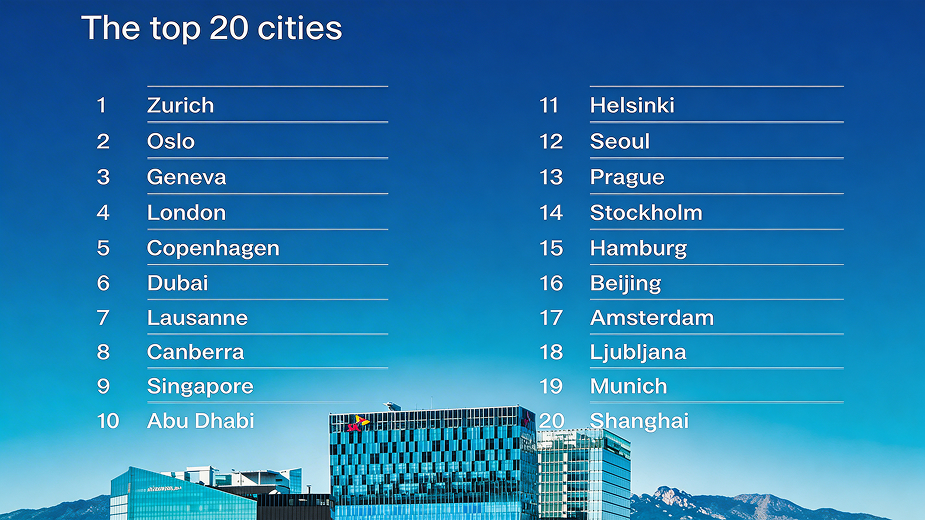
London moved up two positions compared to last year, taking 4th place thanks to the scale of its economy, a developed transport system, a high level of international connectivity and broad opportunities in education, employment and innovation. Cities of the United Arab Emirates – Dubai and Abu Dhabi – entered the Top 10, ranking 6th and 10th, respectively, due to large-scale investments in digitalization, modern infrastructure, intelligent management systems and improving the quality of the urban environment. Singapore retains 9th position for the second year in a row due to a high level of integration of technologies into everyday life, effective governance and quality infrastructure. Copenhagen, Canberra and Lausanne also traditionally rank in the top 10 due to high quality of the urban environment, developed mobility, environmental sustainability, effective governance and active implementation of digital solutions.
Source: report “Smart City Index: Striving for Trust and Transparency” (2026) Cities included in the second ten of the ranking achieved high positions due to a combination of quality urban infrastructure, developed public transport, effective governance and a high level of safety. However, unlike the top ten, their positions are limited by certain weaknesses related to high cost of living and housing, transport congestion, uneven access to urban services, as well as lower ratings from residents in certain aspects of governance, mobility and everyday comfort. At the same time, last year the city of Astana was included in the IMD Smart City Index ranking. In 2026, the city ranked 104th, dropping by two positions compared to 2025. Despite the presence of certain strengths in the field of urban infrastructure and digital services, problems remain that negatively affect residents’ perception of the city. In particular, relatively lower assessments in aspects of governance, environmental conditions, transport mobility and public engagement in urban management processes limit Astana’s position in this ranking. Conclusions The IMD Smart City Index shows that leading positions in the world are occupied by cities that ensure balanced development of urban infrastructure, effective governance, safety, transport mobility and digital solutions. High positions in the ranking are characteristic of cities in which technologies are integrated into everyday life and contribute to improving the quality of the urban environment and the standard of living of the population, and policies are oriented toward the needs of residents. Astana’s 104th place indicates the presence of potential for improving its position, while also pointing to existing systemic constraints. Key areas for further progress include improving the transport situation, increasing housing affordability, improving environmental conditions, developing digital services and enhancing the effectiveness of urban governance. Consistent implementation of these measures will improve the quality of the urban environment and strengthen the city’s position in future editions of the ranking. Zhanerke Bazarbayeva
Leading
Expert of the Center for Regional Studies and Quality of
Life
Views: 2431 |
|
||||||||||||||||||||||||||||||||||||||||||||||||||||||||||||||||||||||||||||||||||||||||||||||||||||||||||||||||||||||||||||||||


|