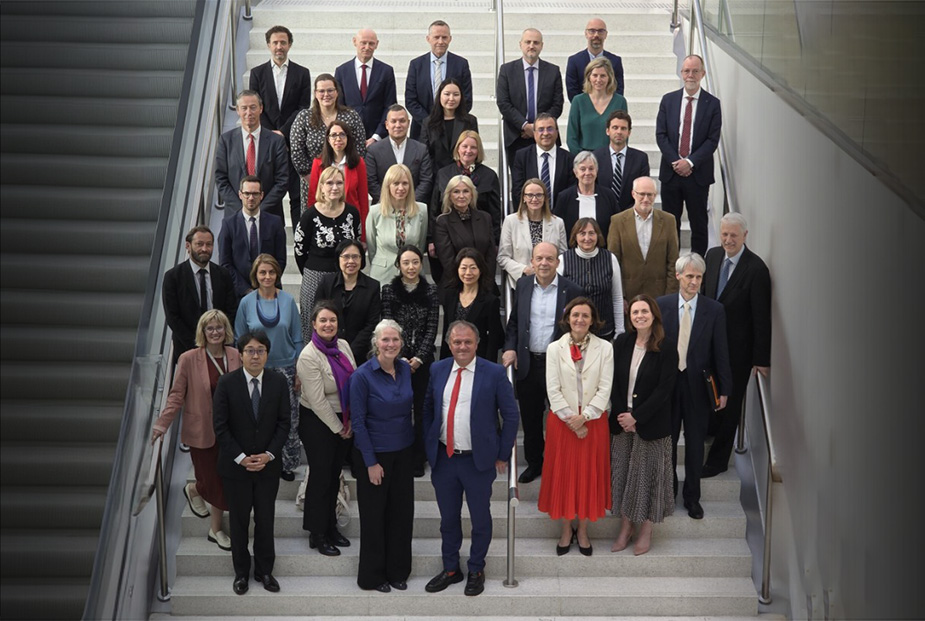
 On April 8–9, 2026, the 73rd meeting of the Public Governance Committee of the Organisation for Economic Co-operation and Development (hereinafter – OECD, the Organization) was held at its headquarters in Paris, France. During the meeting, key priorities were discussed in the areas of strengthening trust in public institutions, improving the effectiveness of public governance, digital transformation, as well as preparations for the Global Forum on Strengthening Democracy to be held in October 2026. From “Economic Research Institute” JSC the meeting was attended by A. Raipov, Director of the Center for World Economy Studies, and A. Musina, Leading Expert of the same Center.
Delegates
paid particular attention to the results of the OECD study on the
drivers of trust in public institutions for 2026. The comparable data
from three survey waves (2021, 2023, and 2025) generated significant
interest, as they allow tracking the dynamics of public trust across
countries. Participants noted the practical value of these data for
the development of national reforms and confirmed the need for their
continued use in policy planning.
During
the meeting, key directions of the “Government Unstuck”
initiative aimed at simplifying public processes and improving their
efficiency were reviewed. Delegates expressed broad support for this
initiative and discussed major reform vectors, including transforming
interactions between the state and citizens, regulatory
simplification, and the development of more proactive public
governance. A number of national practice case studies were
presented, including the experience of Japan
in administrative simplification and the achievements of Estonia
in the application of artificial intelligence.
In
addition, the results of the Digital Government Index (DGI) and the
Open, Useful and Re-usable Data Index (OURdata) for 2025 were
presented. The OECD average DGI score increased by 14% (to 0.70),
with the greatest progress observed in the dimensions of “data
governance” and “proactiveness.” At the same time, a lag was
noted in default data openness and insufficient use of advanced
monitoring methods. Participants emphasized the need for more timely
updates of digital indicators in light of the accelerating pace of
technological development.
Special
attention was also given to the outcomes of the Global
Anti-Corruption and Integrity Forum (GACIF) and the new “OECD
Anti-Corruption and Integrity Outlook 2026.” The report notes that
a key challenge for most countries remains the gap between
legislation and its implementation (implementation gap), particularly
in the areas of conflict of interest and political party financing.
As a solution, a shift from excessive regulation to a risk-based,
digital approach was proposed, including the active use of artificial
intelligence to detect fraud and corruption risks, particularly in
public procurement.
Within
the discussion on updating the Committee’s mandate and the
Programme of Work and Budget for 2027–2030, it was decided to
transfer the Working Party on Performance and Results to the Budget
Committee. Participants supported the proposed approach to
prioritizing activities with a focus on simplifying government,
digital transformation, and strengthening trust, and also emphasized
the importance of maintaining funding for public governance as a key
driver of all economic and social reforms.
The
presentation by Costa
Rica,
showcasing its experience in implementing reforms following accession
to the OECD, was positively received by delegates and was seen as an
example of consistent advancement of institutional reforms. It was
noted that Costa Rica’s experience is of particular relevance for
Kazakhstan and may be useful in the context of further preparations
for accession to the Organization.
As
part of the preparations for the Global Forum on Strengthening Trust
and Democracy (October 12–13, 2026), delegates emphasized the
importance of expanding international participation and strengthening
the democratic agenda.
A.
Raipov actively participated in the discussions on key agenda items.
In his remarks, he emphasized the importance of the “Government
Unstuck” initiative for Kazakhstan in the context of the Year of
Digitalization and Artificial Intelligence announced by the
President, and presented the country’s approaches to simplifying
public processes, digital transformation, and building a proactive
state based on citizens’ trust.
Following
the meeting, participants reaffirmed their commitment to further
strengthening trust in public institutions, improving the
effectiveness of public governance, and advancing inclusive digital
transformation.