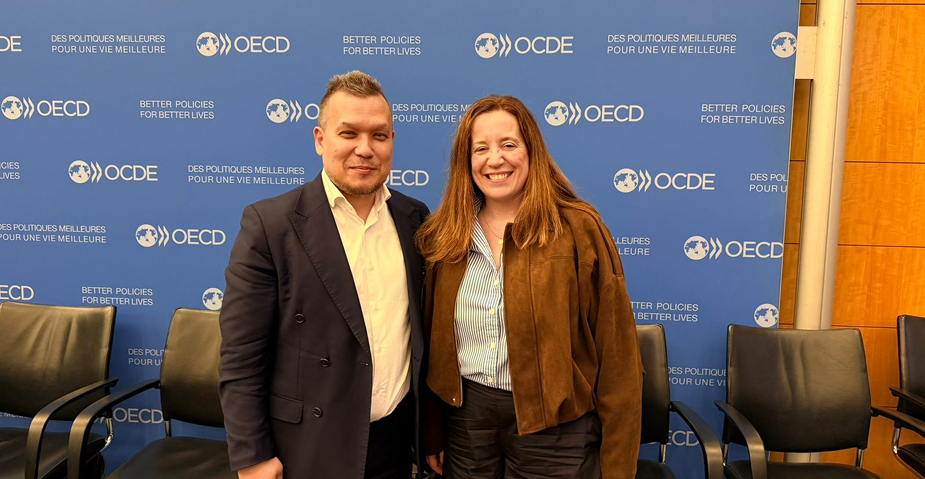
 Alibek Raipov, Director of the World Economic Research Center at the Economic Research Institute, took an active part in three consecutive events of the Organisation for Economic Co-operation and Development (OECD) dedicated to digital transformation, financing, and policy support for small and medium-sized enterprises (SMEs).
The
events took place at the OECD headquarters in Paris, France,
according to the following schedule:
April
13 2026–
7th High-Level Meeting of the Global Initiative "Digital for
SMEs" (D4SME);
14–15
April 2026 – 10th
meeting of the Committee on SMEs and Entrepreneurship (CSMEE);
16
April 2026
– meeting of the International Network for Policy Evaluation in
SMEs and Entrepreneurship (INSPEN).
During
the working meetings, the expert from Kazakhstan delivered
presentations, participated in panel discussions and presented
Kazakhstan's position on key agenda items, including the
implementation of artificial intelligence, access to finance, and
assessing the effectiveness of entrepreneurship support measures.
Participants—representatives of OECD member countries, business
associations, and international expert groups—in turn actively
discussed the presented cases, shared national experiences, and
jointly developed recommendations for adapting policies to rapidly
changing conditions.
On
April 13, 2026, the 7th High-Level Meeting of the OECD Global
Initiative "Digital for SMEs" (D4SME) was held. The meeting
focused on enhancing the competitiveness of SMEs through
digitalization and the use of AI. The focus was on the new
capabilities of agent-based AI, as well as barriers related to
cybersecurity and data protection. Alibek Raipov spoke in the first
part of the meeting, emphasizing the importance of adapting SME
support policies to the rapidly changing technological landscape. He
noted that Kazakhstan, which declared 2026 the Year of Digitalization
and Artificial Intelligence, views the D4SME initiative as a valuable
tool for sharing experiences and developing practical
recommendations. During the discussion, Raipov also addressed the
information security of small businesses using AI and the need to
create simplified risk management guidelines. Other participants in
the meeting, in turn, presented specific examples of using
agent-based AI in logistics, retail, and manufacturing, and shared
their experiences implementing national digital literacy programs for
SMEs.
On
April 14–15, 2026, the 10th meeting of the Committee on SMEs and
Entrepreneurship (CSMEE) was held to discuss strategic work areas for
2027–2030, including the Program of Work and Budget (PWB), as well
as a number of sector reports. Alibek Raipov actively participated in
the discussion of key agenda items. He addressed the renewal of the
CSMEE mandate, emphasizing the need to maintain a focus on
simplifying regulations and improving data collection. During the
discussion of the PWB for 2027–2030, a representative of Kazakhstan
presented a ranking of the country's priorities, noting the
importance of areas such as access to finance, digitalization and AI
for SMEs, and the development of start-ups and scale-ups. Raipov also
commented on the report "Financing SMEs and Entrepreneurs 2026:
An OECD Scoreboard," noting the need to expand coverage of
partner countries and improve the collection of disaggregated data by
gender, sector, and region. He also supported the findings of the
"Fit for Future Manufacturing SMEs" project on the need for
sector-specific policies for the automotive, electronics, and
mechanical engineering industries and noted Kazakhstan's successful
experience in integrating green incentives into entrepreneurship
support programs, emphasizing the importance of simplifying carbon
reporting procedures for SMEs. During the discussion, delegates from
various countries exchanged views on the priorities of the future
Work Program, with significant attention paid to simplifying the
regulatory environment and improving the monitoring of policy
effectiveness.
On
April 16, 2026, the International SME and Entrepreneurship Policy
Evaluation Network (INSPEN) met to discuss two topics: evaluating
scale-up support programs and developing indicators for monitoring
policy effectiveness. Alibek Raipov spoke at the first session of the
meeting, which focused on assessing the impact of non-financial
support measures using the example of the Bpifrance accelerator. He
emphasized the relevance of such research for Kazakhstan, which is
currently reforming its business incubation and acceleration system,
and proposed that the OECD consider jointly analyzing Kazakhstan's
programs. In the second session, which focused on monitoring
indicators, Raipov noted the importance of standardizing approaches
to measuring policy effectiveness, especially given regional
differences. During a lively discussion, INSPEN network participants
presented national approaches to monitoring, including Estonia's
experience tracking the effectiveness of startup policies and
Poland's practice of collecting data on the effectiveness of support
measures. A common theme was finding a balance between the detail of
indicators and the administrative burden on SMEs.
The
obtained materials as well as the summarized findings of colleagues
from other countries, will be used in preparing national reforms in
the area of SME and entrepreneurship support, including the
development of new approaches to digitalization, green transition,
and assessing the effectiveness of support measures. The
participation of a Kazakhstani expert in OECD events contributes to
the further alignment of national entrepreneurship support standards
with international best practices and strengthens Kazakhstan's
position as a reliable partner for the OECD in SME development.