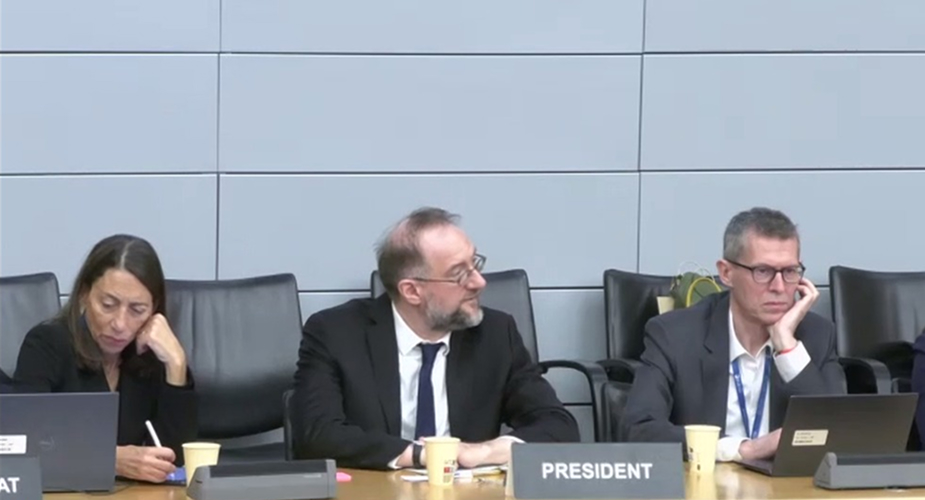
 On April 20-21 2026, a hybrid meeting of the Advisory Task Force on the OECD Codes was held at OECD headquarters. The meeting was dedicated to global imbalances and international capital flows. Representatives of the Economic Research Institute (ERI) participated in the event.
Representatives
of leading international and national institutions also participated:
the French and US Ministries of Finance, the US Federal Reserve, the
European Central Bank, the Bank of England, the Massachusetts
Institute of Technology (MIT), and the OECD.
During
the meeting, participants discussed key trends in international
finance, paying particular attention to the role of cross-border
capital flows in shaping global imbalances. It was noted that this
issue is once again coming to the forefront of the international
agenda, including in the context of the priorities of the G20 and G7.
The
central theme of the discussion was the thematic session «Global
Imbalances and International Capital Flows» which
examined the relationship between global imbalances and capital
flows. Participants emphasized that analysis solely through the lens
of the current account is insufficient: financial
flows, international investment positions, and asset valuation
effects are playing an increasingly important role.
Key
finding: financial imbalances can
be a more significant source of macroeconomic shocks than traditional
current account imbalances. In this regard, the need to expand the
analytical framework was discussed, including
assessing financial sustainability and the risks of a sharp
adjustment in global positions.
During
a separate session dedicated to country cases, participants examined
the following topics:
•
capital
inflow dynamics and their impact on foreign exchange markets;
•
growth
of the FX derivatives market;
•
structural
changes in the foreign exchange markets of emerging economies;
•
policy
dilemmas between developing domestic financial markets and managing
exchange rate volatility.
The
meeting addressed the role of non-bank financial institutions
(NBFIs), whose importance has increased significantly since the 2008
global financial crisis, as well as capital flow regulation: capital
controls have limited effectiveness, while remaining a tool for
reducing short-term volatility.
The
meeting concluded by emphasizing the need for a comprehensive
approach to analyzing global imbalances, taking into account not only
foreign trade indicators but also:
•
financial
flows,
•
asset
structure,
•
institutional
changes in the global economy,
•
risks
of a sharp adjustment in global positions (sudden
stop of capital).
It
is recommended that when
analyzing imbalances, special
attention be paid to
financial stability and
the
role of the non-banking financial sector.