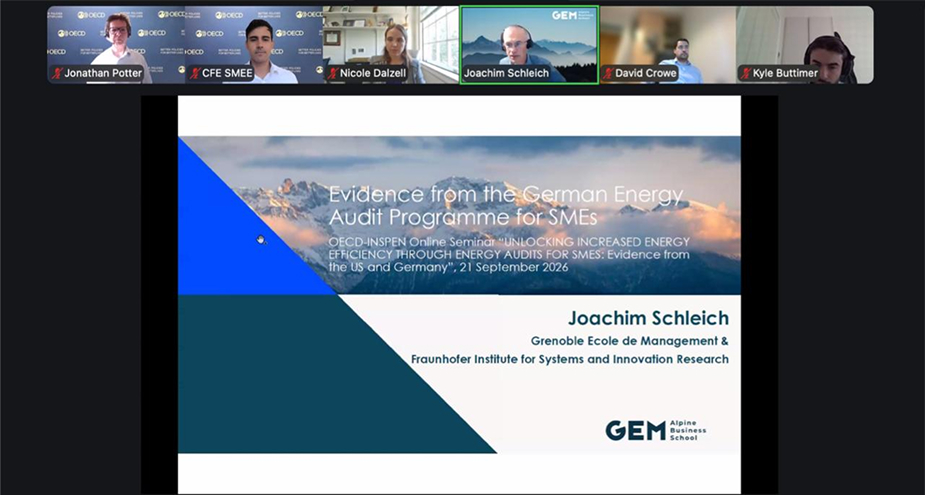
 On 21 September 2026, representatives of the Economic Research Institute participated in an online semina.organised by the Organisation for Economic Co-operation and Development (OECD) within the framework of the International SME and Entrepreneurship Policy Evaluation Discussion Network (INSPEN).
The
event, entitled “Unlocking Increased Energy Efficiency through
Energy Audits for SMEs: Evidence from the US and Germany”, focused
on the role of energy audits in improving the energy efficiency of
small and medium-sized enterprises.
The
seminar focused on evidence from the United States and Germany
concerning the extent to which energy audits can influence subsequent
business behaviour and encourage the implementation of measures to
reduce energy consumption. Representatives of the OECD, public
authorities, researc.organisations and universities took part in the
discussion.
Nicole
Dalzell, Professor at Wake Forest University, presented the findings
of a study of the U.S. Industrial Assessment Center (IAC)
programme administered by the U.S. Department of Energy. The
programme provides small and medium-sized manufacturing enterprises
with no-cost assessments to identify opportunities to reduce energy
use, production costs and waste. Particular attention in the study
was given to the evaluation methodology. To estimate the programme’s
impact, data from enterprises that had received an energy assessment
were compared with data from similar firms that had not participated
in the programme. The results showed improvements in energy
efficiency among assessed enterprises compared with their industry
peers.
The
German experience was presented by Joachim Schleich, Professor at
Grenoble École de Management and the Fraunhofer Institute for
Systems and Innovation Research. The study of Germany’s subsidised
voluntary energy audit programme showed that such advisory support
encourages firms to implement measures related to lighting,
insulation, heating systems and the optimisation of production
processes. An evaluation using a control group found that the
probability of implementing relevant measures increased by
approximately 10–20 percentage points. The strongest effects were
identified for insulation and the optimisation of energy equipment
operations.
The
discussion also covered Ireland’s experience in promoting energy
audits and adapting national policy to changing energy efficiency
requirements. Participants highlighted the need to take into account
differences among firms in terms of size, energy consumption and
internal capabilities. It was also noted that financial support alone
does not guarantee the implementation of recommendations when SMEs
lack the necessary knowledge, resources or capacity for follow-up
investment.
The
seminar concluded that energy audits can be an effective instrument
for supporting the green transition of SMEs. However, the
effectiveness of such programmes depends significantly on the quality
of programme design and subsequent evaluation. Comparing programme
participants with control groups, linking administrative and
statistical data, and analysing the actual implementation of
recommendations can provide a more accurate assessment of the impact
of public support and help improve SME energy efficiency policies.