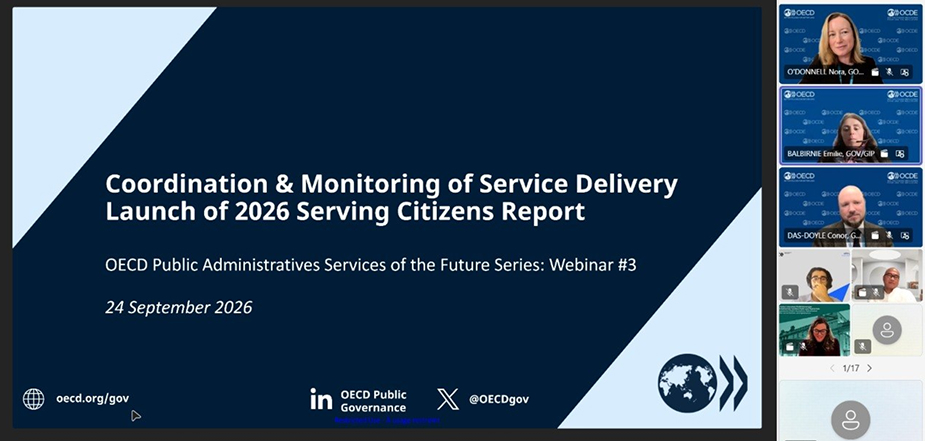
 On 24 September 2026, representatives of JSC “Institute of Economic Research” participated in the third webinar of the Organization for Economic Co-operation and Development (OECD), dedicated to coordination, monitoring and improving the quality of public administrative services.
During
the webinar, the OECD presented the key findings of its new report
Serving
Citizens 2026: Delivering Better Public Administrative Services,
which examines countries’ approaches t.organizing public services
based on citizens’ needs.
According
to OECD data, 68% of recent users of public administrative services
across OECD countries were satisfied with their quality, while 19%
expressed dissatisfaction. The Serving
Citizens
survey covered 37 countries, including 31 OECD countries and 6
non-OECD countries. It also assesses the implementation of the OECD
2024 Recommendation on Human-Centered Public Administrative Services.
One
of the key areas highlighted was the development of a unified
strategic approach to public service delivery. In 87% of OECD
countries, a government-wide strategy is in place in this area. At
the same time, the OECD emphasizes the need to establish stronger
links between strategic objectives and the mechanisms for
implementation, monitoring and evaluation, as well as the required
skills and resources.
Particular
attention during the webinar was given to inter-agency coordination.
In 71% of OECD countries, inter-agency bodies or committees
responsible for improving public administrative services have been
established. Their responsibilities include coordinating the work of
public authorities, monitoring reforms and simplifying service
delivery procedures.
The
webinar also examined the approach o.organizing public services
around citizens’ life events, such as the birth of a child,
retirement, change of residence or starting a business. This approach
is already applied in some form in 77% of OECD countries. However,
full integration of services involving data exchange between public
authorities is currently achieved in only 20% of cases. In a further
40% of cases, information on the services required is consolidated on
a single platform, while the services themselves remain
organizationally separate.
The
use of feedback and performance data remains an important element in
improving service quality. User surveys are conducted in 94% of OECD
countries, while 74% establish service performance indicators.
However, only 55% use data on performance and user experience
directly to improve services, and 45% use such data in policymaking.
As
a practical example, the experience of Ireland was presented, where
public service development is based on a unified strategic approach,
inter-agency coordination and improving the quality of interaction
between citizens and public authorities.
The
webinar highlighted that further development of public services
requires not only digitalization, but also closer coordination among
public authorities, the integration of services around citizens’
needs, and the systematic use of feedback and data. Digital
technologies, in this approach, serve not as an end in themselves,
but as a tool for creating a more accessible, coordinated and
citizen-centered system of public services.