Kazakhstan Moved Up Three Positions in the SDG Ranking
24.06.2026
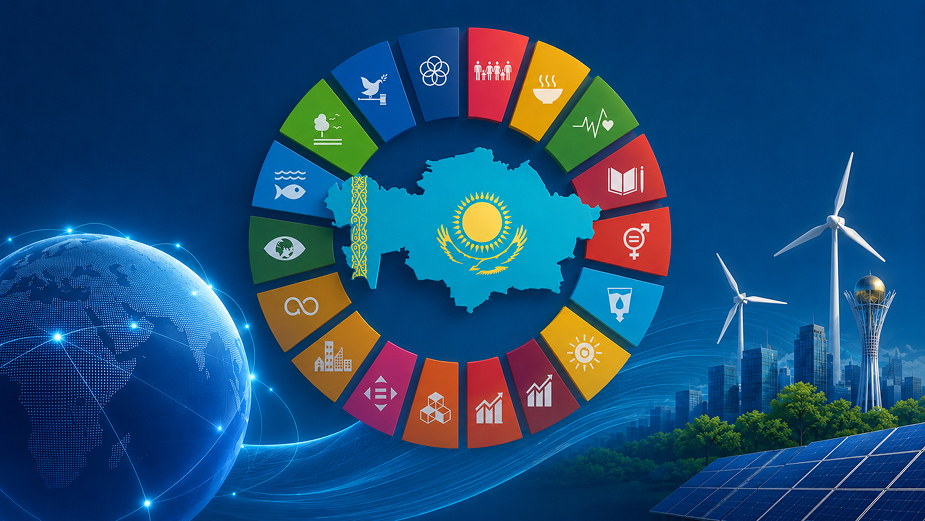 In 2026, Kazakhstan ranked 67th out of 169 countries in the Sustainable Development Goals (SDG) Index, improving its position by three places compared to 2025. The country’s overall score increased from 71.5 to 72.0. It is important to note that the SDSN report places particular emphasis on the need for practical mechanisms to implement the SDGs as the 2030 Agenda approaches its final stage. Kazakhstan outperformed several G20 countries, including Indonesia (74th place; 70.8 points), Mexico (75th place; 70.5 points), Türkiye (77th place; 70.2 points), India (94th place; 68.3 points), Saudi Arabia (104th place; 65.9 points), and South Africa (109th place; 65.2 points). Among Central Asian countries, Kazakhstan also ranked higher than Tajikistan (98th place; 67.8 points) and Turkmenistan (128th place; 59.9 points), while trailing the Kyrgyz Republic (50th place; 74.6 points) and Uzbekistan (65th place; 72.9 points). Overall, Kazakhstan demonstrates mixed progress in achieving the Sustainable Development Goals. While steady advancement and improvements are observed in a number of areas, certain sectors still require additional attention. The country has virtually eliminated poverty and remains on track to achieve the corresponding goal. Positive developments have also been recorded in food security, clean energy, water supply and sanitation, infrastructure, and innovation. For example, under SDG 1 “No Poverty,” Kazakhstan consistently demonstrates results comparable to those of several OECD countries. According to the indicator “Proportion of the population living below USD 3.00 per day,” the country’s value stands at 0.8%, which is close to the levels observed in Latvia (0.5%), Hungary (0.6%), and Norway (0.1%). Under SDG 2 “Zero Hunger,” exports of hazardous pesticides decreased from 3.8 to 3.5 tonnes per one million population. Under SDG 3 “Good Health and Well-being,” the under-five mortality rate declined from 9.6 to 9.4 per 1,000 live births. Under SDG 6 “Clean Water and Sanitation,” access to basic drinking water services improved from 95.4% to 97.8%. At the same time, freshwater withdrawals decreased from 34.6% to 33.6%, while the volume of water embedded in imported goods whose production requires scarce water resources fell from 2,248.3 m³ to 2,165.8 m³ per capita. Under SDG 9 “Industry, Innovation and Infrastructure,” the number of mobile broadband subscriptions increased significantly, from 91.6 to 119 per 100 people. The average score of Kazakhstani universities in the Times Higher Education ranking rose from 30.1 to 32.1, while the number of patent applications increased from 79.7 to 82.1 per one million population. At the same time, further progress is needed in several areas. Compared to 2025, a number of education-related indicators deteriorated, while stagnation was observed in certain indicators related to justice and institutional effectiveness. In addition, continued efforts are required in areas that remain categorized as “serious” and “significant” challenges in the SDG Index. These include gender equality, clean energy, responsible consumption and production, reduced inequalities, climate action, and the protection of terrestrial ecosystems. Reference: The UN-Mi Index presented in the SDSN report assesses countries’ support for the principles of multilateralism within the United Nations system. The index covers all 193 UN Member States and is based on six key indicators: ratification of UN treaties, voting patterns in the UN General Assembly, participation in UN syste.organizations, militarization, the use of unilateral coercive measures, and contributions to the UN budget. In 2026, the average UN-Mi score stood at 65 out of 100. Kazakhstan ranked 31st with a score of 77.4, placing it among the countries demonstrating very strong support for the principles of multilateralism within the UN system. The SDSN 2026 report also introduced, for the first time, an expert survey assessing government efforts to integrate the SDGs into public administration systems. The survey covers such aspects as the integration of SDGs into public policy and strategies, indicator frameworks, budgeting processes, and interagency coordination mechanisms. Kazakhstan was the only Central Asian country included in the survey and received positive assessments in 5 out of 7 areas, confirming the strategic importance of the SDGs within the country’s public policy framework. Reference: When interpreting the SDG Index results, a number of limitations should be taken into account. The final scores depend on the availability, quality, and comparability of data across countries. Indicator values are derived from both official and non-official sources, while detailed source information is not always provided in the report. Furthermore, methodological factors, including indicator normalization and the use of estimated values for certain indicators, may influence the results. Therefore, the SDG Index should primarily be viewed as a tool for monitoring and international comparison rather than as a definitive assessment of a country’s sustainable development achievements. Overall, the SDG Index results indicate that Kazakhstan is making steady progress toward achieving the Sustainable Development Goals and strengthening the institutional foundations for their implementation. At the same time, further progress will require enhanced efforts in such areas as education, gender equality, clean energy, responsible consumption and production, reducing inequalities, climate action, the preservation of terrestrial ecosystems, as well as justice and institutional effectiveness.
Views: 1688 |
|
||||||||||||||||||||||||||||||||||||||||||||||||||||||||||||||||||||||||||||||||||||||||||||||||||||||||||||||||||||||||||||||||


|