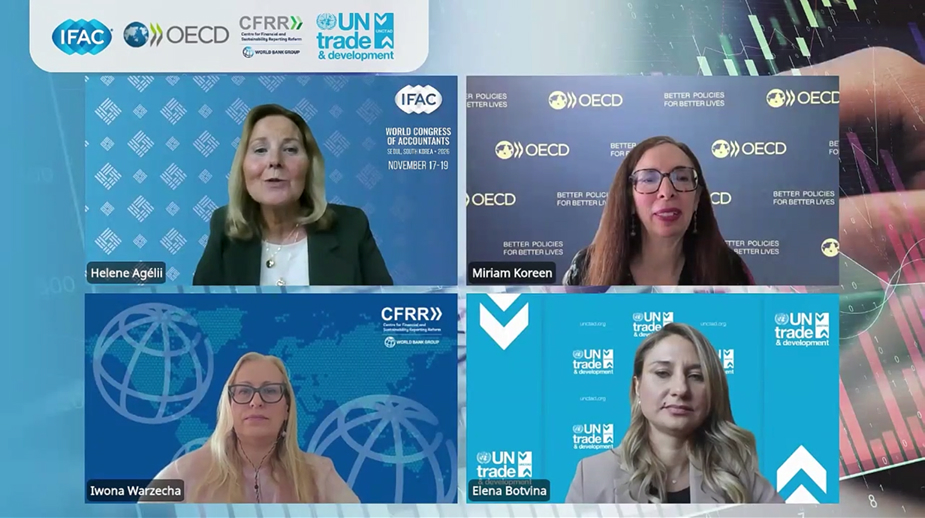
 On 26 June 2026, representatives of the Economic Research Institute took part in an international webinar held to mark the United Nations Micro, Small and Medium-sized Enterprises Day.
The event, entitled
“Strengthening
SME Access to Finance in Turbulent Times: Building Resilient
Ecosystems”,
was jointl.organised by the International Federation of Accountants
(IFAC),
the Organisation for Economic Co-operation and Development (OECD),
the World Bank Group’s Centre for Financial and Sustainability
Reporting Reform (CFRR),
and the United Nations Conference on Trade and Development (UNCTAD).
The
webinar was moderated by Helene
Ageli,
Chair of IFAC’s Small and Medium Practices Advisory Group. The
discussion featured Miriam
Koreen,
Senior Adviser and Head of the SME and Entrepreneurship Finance Unit
at the OECD Centre for Entrepreneurship, SMEs, Regions and Cities,
Iwona
Warzecha,
Senior Financial Management Specialist at the World Bank Group, and
Elena
Botvina,
Economic Affairs Officer at UNCTAD’s Division on Investment and
Enterprise.
The
discussion focused on the impact of heightened
uncertainty,
tighter
financial conditions
and increasingly complex
reporting requirements
on SME access to finance. Participants noted that the financial
resilience of SMEs depends not only on the availability of credit.
The quality of financial information, predictability of the
regulatory environment, timely payments between customers and
suppliers, and the capacity of firms to select appropriate financial
instruments are also important.
Miriam
Koreen, representing the OECD, emphasized the need to diversify
sources of SME finance.
Alongside bank lending, businesses should make broader use of
guarantee instruments, factoring, leasing, venture capital, trade
finance and other non-bank mechanisms. Particular attention was given
to expanding financing opportunities for innovative firms and
start-ups, including the use
of intangible assets to attract investment.
Timely payments under contracts between businesses, as well as
between public purchasers and SME suppliers, were also identified as
a priority.
Iwona
Warzecha presented the World Bank Group’s approach to developing a
resilient financial ecosystem for SMEs. In her view, expanding access
to finance requires the simultaneous
development
of legal insolvency frameworks, proportionate reporting requirements,
specialised banking products and risk assessment mechanisms. It was
noted that countries with developing financial markets should place
particular emphasis on non-bank
instruments,
including fintech solutions, factoring, leasing and movable
collateral registries. The importance of involving large companies in
supply chain finance mechanisms was also highlighted.
During
the discussion, Elena Botvina underlined the role of digital
accounting,
electronic invoicing, cashless payments and cloud-based business
management systems in improving transparency among SMEs. These
instruments enable enterprises to generate more reliable financial
data for engagement with banks, investors and business partners.
Artificial
intelligence
and alternative data can accelerate document processing, remote
customer identification, creditworthiness assessments and risk
monitoring. At the same time, participants stressed that the use of
such technologies requires safeguards to ensure algorithmic
transparency, prevent discriminatory outcomes and preserve the
ability to challenge automated decisions.
The
webinar concluded that expanding SME access to finance requires
coordinated action by public authorities, the financial sector,
internationa.organisations, professional associations and the
business community. Key directions identified included the
diversification of financial instruments, improvement of the quality
and accessibility of financial information, deployment of digital
solutions with appropriate safeguards, reduction of unnecessary
administrative burdens and strengthening trust between enterprises
and financial service providers.