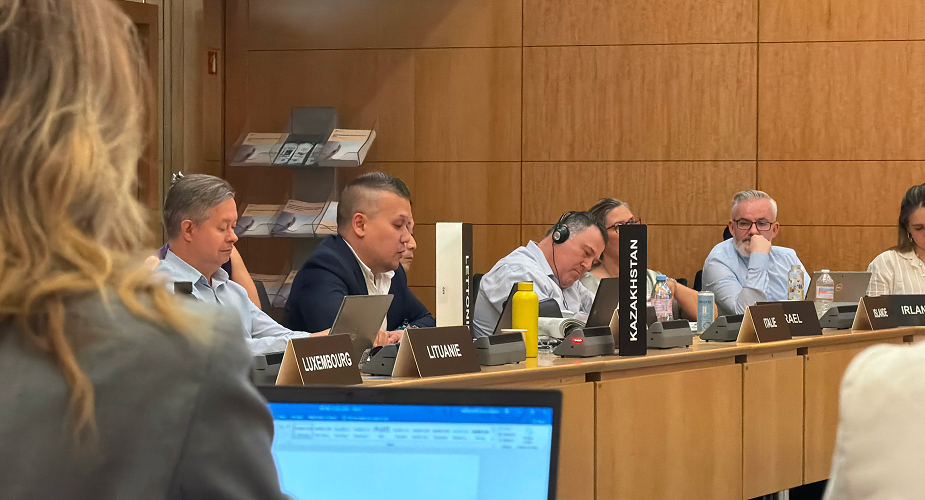
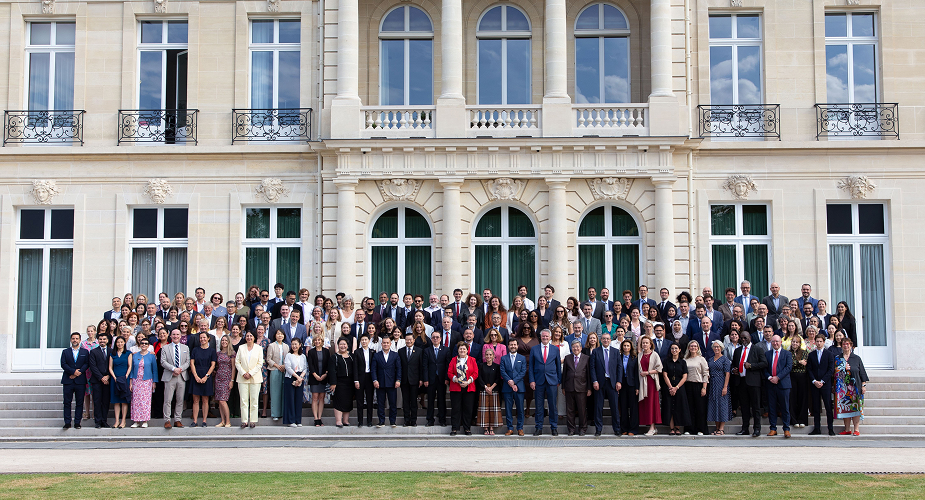
 A delegation from the Economic Research Institute JSC, representing the Secretariat of Kazakhstan’s National Contact Point for Responsible Business Conduct, actively participated in the OECD Responsible Business Conduct Week, held to mark the 50th anniversary of the OECD Guidelines for Multinational Enterprises. Kazakhstan was represented by Alibek Raipov, Director of the Center for World Economy Studies, and Azhar Alisheva, Senior Expert at the Center.
Over four days, the Kazakh
delegation participated in all key events of OECD Responsible
Business Conduct Week: the confidential session on specific instances
and the meeting of the Network of National Contact Points on 29 June,
the OECD Global Forum on Responsible Business Conduct on 30 June, the
third meeting of the Inclusive Platform for Cooperation on Due
Diligence Policies on 1 July, and the meeting of the OECD Working
Party on Responsible Business Conduct on 2 July.
Kazakhstan actively
contributed to the professional discussions. During the confidential
session, representatives of the National Contact Point took part in a
closed-door dialogue and exchanged experience and good practices in
handling complex specific instances. The discussions covered
confidentiality, the use of non-disclosure agreements, the protection
of complainants, the assessment of whether submissions met the
initial assessment criteria, and th.organisation of mediation
procedures. At the meeting of the Working Party, the Kazakh
delegation asked representatives of the Israeli NCP about the
practical application of impartiality requirements, additional
safeguards for preventing conflicts of interest, and mechanisms for
strengthening trust among civil societ.organisations, trade unions
and individual complainants.
At the meeting of the
Inclusive Platform, the delegation participated in plenary and
government discussions on the effective design, implementation and
enforcement of due diligence policies. During the thematic breakout
sessions, the representatives of Kazakhstan discussed common
approaches to determining risk, criteria for assessing the severity
and likelihood of adverse impacts, methods for prioritising risks,
and the practical challenges of applying these approaches across
global supply chains.
An important outcome of the
Week was the presentation of a new package of OECD analytical and
practical resources. These included the OECD Responsible Business
Outlook 2026: Making Commitments Count, the Annual Report on the
Activities of National Contact Points for 2025, and the OECD RBC
Policy Navigator digital tool. Participants also reviewed the draft
documents Key Considerations for the Effective Design, Implementation
and Enforcement of Due Diligence Policies and Determining Risk under
Social and Environmental Due Diligence Policies. These materials
provide a solid foundation for improving public policy, corporate due
diligence and mechanisms for access to remedy.
One of the key conclusions of
the international discussions was the recognition that responsible
business conduct is no longer viewed as an additional cost. On the
contrary, it is now regarded as an effective economic and investment
policy tool that can reduce regulatory, reputational and operational
risks, strengthen the resilience of supply chains and reinforce
investor confidence. The OECD provides a unique platform for
developing coordinated approaches to responsible business conduct
among governments, businesses, workers and civil society.
Participation in OECD
Responsible Business Conduct Week made it possible to clearly
identify the next priorities for developing Kazakhstan’s national
responsible business conduct system. These include improving NCP
procedures, strengthening inter-agency coordination, introducing a
risk-based approach to due diligence, and integrating responsible
business conduct principles into investment policy, public
procurement and supply chain management. The materials and
international good practices obtained during the Week will be used to
strengthen the institutional capacity of Kazakhstan’s NCP and
enhance the competitiveness of Kazakh enterprises in sustainable
regional and global value chains.