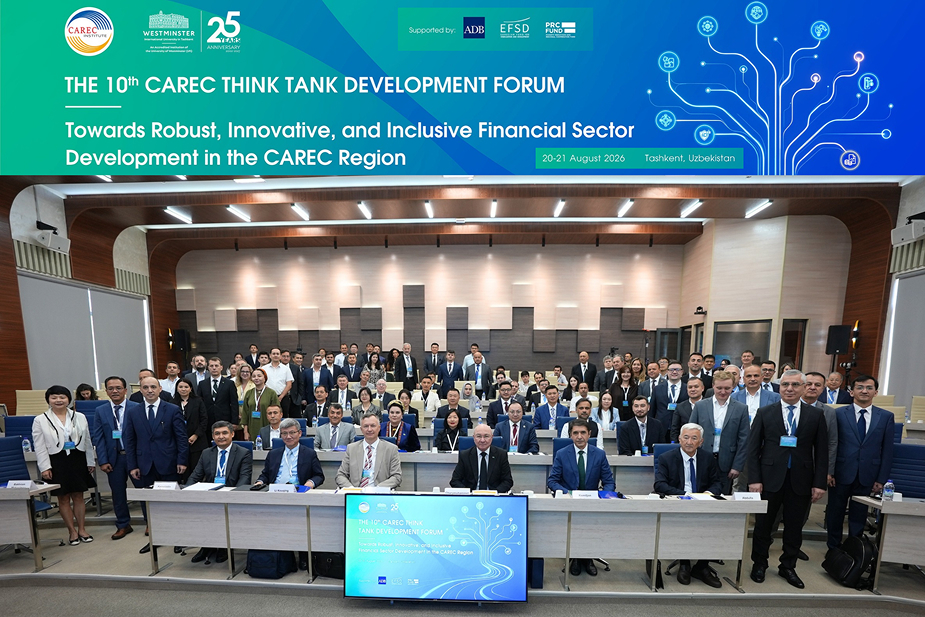
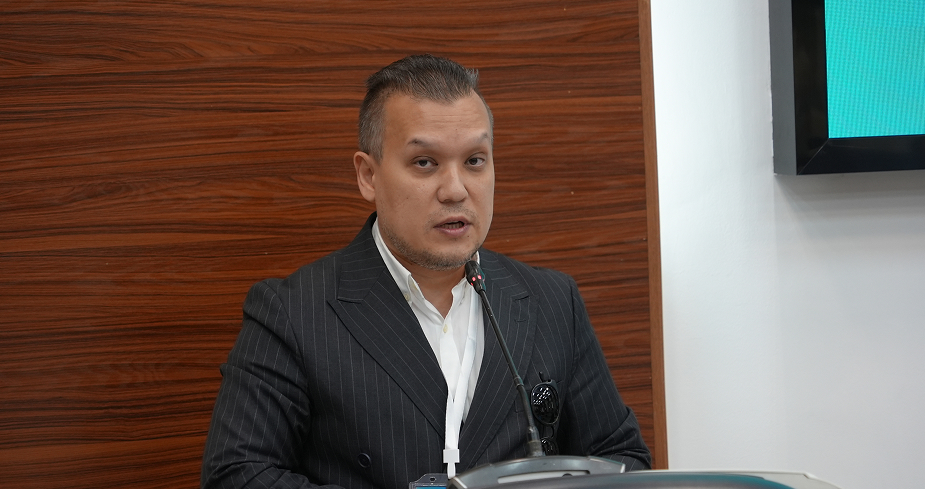
 On 20 and 21 August 2026 in Tashkent, Uzbekistan, Alibek Raipov, Director of the World Economy Research Center at Economic Research Institute JSC, participated in the 10th CAREC Think Tank Development Forum (CTTDF) under the Central Asia Regional Economic Cooperation Program. The event focused on the theme “Towards Robust, Innovative, and Inclusive Financial Sector Development in the CAREC Region.”
During
the two-day program, participants discussed a broad range of issues,
including digital finance and fintech, expanded financial inclusion,
the development of non-bank financing channels, and the mobilization
of long-term investment. Particular attention was given to financial
literacy, venture capital, direct investment, and the financial
sector’s resilience to macroeconomic and currency shocks. On the
second day, participants also considered prospects for regional
financial cooperation, including cross-border banking, regulatory
harmonization, regional payment systems, and capital market
interconnectedness.
On
the second day of the forum, Alibek Raipov spoke at the technical
session “CAREC Think Tank Network. Progress and Next Steps.” The
session focused on the results of the CAREC Think Tank Network
(CTTN), its current initiatives, and measures to strengthen its role
in regional cooperation and policy dialogue.
In
his remarks, Alibek Raipov emphasized that CTTN has already
established itself as an important regional platform bringing
together think tanks from 11 CAREC countries. He noted that the
Network is becoming increasingly important amid the fragmentation of
trade flows, the restructuring of logistics chains, the acceleration
of green and digital transitions, and growing uncertainty in the food
and energy sectors.
Speaking
on behalf of the Economic Research Institute (the Institute), he
emphasized the importance of joint regional research, engagement with
decision makers, and access to the regional expert network. These
formats facilitate the development of findings with practical value
for government agencies and international partners, while integrating
Kazakhstan’s expertise into the common regional analytical agenda.
As next steps, he proposed strengthening the link between research
and public policy needs, developing thematic working groups and
expert formats between annual forums, and considering the creation of
a single digital platform for knowledge and partnerships.
Building
on the discussions held during the Forum sessions on investment
mobilization and the strengthening of national financial systems,
Alibek Raipov presented information on the activities of Kazakhstan’s
National Contact Point (NCP) for responsible business conduct. He
noted that the NCP supports implementation of the OECD Guidelines for
Multinational Enterprises and serves as a platform for dialogue among
government, business, and civil society. The Institute provides
analytical and expert support to the NCP, including the preparation
of materials and training on due diligence, which helps enhance
investment attractiveness and strengthen trust in the business
environment across Central Asia.
At
the conclusion of the forum, participants agreed that developing the
CAREC region’s financial sector requires a combination of
technological innovation, expanded financial inclusion, alternative
sources of financing, and stronger regional cooperation. The
Institute’s participation in the Forum provided an opportunity to
present Kazakhstan’s expertise and reaffirm its readiness to
continue working within CTTN.